Saturday, November 23, 2024

Watch picture and learn character (26) Well - 井

 The evolution of the Character Well


From Left to Right: Shell Bone, Big Seal, Small Seal, Clerical Scripts


Four-sided Well


Pinyin of character Well: Jing3.


Explanation


Shell Bone Script: Represents the shape of a four-sided well. In ancient times, the well's mouth was likely framed with wooden guardrails, which is depicted in this character. Later, stone replaced wood, and the corners became right angles. Four-sided wells are now rare in China but can still be found, especially in the south. In my hometown of Zhijiang, Hunan, these wells were common during my childhood, although the well edges were lower than shown in the pictures. Few remain now. In the north, round wells with smaller openings at the top are more common. Four-sided wells might be scarce in the north due to deeper water levels and loose soil, making vertical four-sided wells more prone to collapse. In the south, where water levels are higher, wells are usually found within two to three meters, and the soil is more compact, making open four-sided wells feasible. These wells are wide enough for multiple people to draw water simultaneously. The four-sided wells in Zhijiang had wide stone surroundings and cement platforms, convenient for washing clothes and vegetables.


Big Seal Script: Similar to the Shell Bone Script but includes an extra dot in the middle. This dot serves as an indicator to clarify that it refers to the well itself and its water, not just the mouth. This likely corrected misunderstandings from the Shell Bone Script depiction.


Small Seal Script: Resembles the Big Seal Script. Both Big and Small Seal Scripts are indicative characters due to the middle dot. However, the Shell Bone Script, Clerical Script, and Song-style characters are not indicative. The reason why there are fewer indicative characters in Song-style is due to simplification, which removed the dot, transforming indicative characters into non-indicative ones. Understanding the evolution of Chinese characters provides a comprehensive grasp of their meanings, aiding in learning.


Clerical Script: Returns to the shape of the Shell Bone Script.


This translation explains the evolution of the Chinese character "" across different historical scripts and provides context about its cultural and practical significance in ancient and modern China.

Watch picture and learn character (25)Nest - 巢

 The evolution of the Character Nest


From left to right: Big Seal, Small Seal, Clerical Scripts, Song Typeface


Illustration: A bird’s nest in a tree.


Pinyin of the character: Chao2


Explanation


Big shell script of Nest: The top part represents bird feathers, the middle part is a bird's nest, and the bottom part is the character for wood (), which signifies a tree.


Small Seal Script of Nest: Similar to Big Seal Script.


Clerical Script of Nest: The top part has transformed into "", which means a river and is not related to the original meaning. The middle nest part has changed to "", and together with the "" at the bottom, it now forms "", which is unrelated to the original meaning. The pictographic nature is mostly lost.


Song Typeface of Nest: Similar to Clerical Script.


Watch picture and learn character (24)Teach - 教

The evolution of character Teach


From left to right: 

Shell bone, bronze, big seal, small seal, clerical scripts


 Private School teach punish the student who didn't do well.


Pinyin taught: Jiao4


Explanation 


Shell bone script: The two X's on the upper left are small sticks for counting, and the "子" (A round head and small body) on the lower left is a child. Below on the right is a hand holding a stick. When children learn to count, if they do not do well, they will be punished by their teachers or parents.


Bronze script: The two Why use divination instead of stick? Not sure.


Big seal script: Much more beautiful than bronze inscriptions. In fact, bronze inscriptions and most Big seals are cast on metal (bronze). Bronze script is earlier than big seal, which are hundreds of years later. Generally, the characters in bronze scripts are few and unsightly. The reason was mainly due to the poor casting technology at that time.


Small seal script: similar to big seal script.


Clerical script: On the left side is the word "" plus a stroke, which is the transformation of two X's. Think of "" as an X, and the remaining "one horizontal + one stroke falling left" is another X.


You may ask: Why such a big change? Who did it? People from the Han Dynasty. The people of the Han Dynasty were the boldest in Chinese history, so the Han Dynasty was a great dynasty. Not to mention other aspects, but in terms of Chinese characters, the curves of the seal script are straightened. How bold is that change? Historically known as the "Clerical Revolution", it was a watershed in the development of Chinese characters, from pictographic ancient Chinese characters to horizontal and vertical modern Chinese characters. Think this could happen today? Absolutely impossible. In a calligraphy competition, if you write a typo, you will immediately lose. Sometimes it’s not a typo, but a variant of the character, that is to say, there is such a way of writing, and even great calligraphers have written it, but the judges may not know, and think you have a typo, and you are finished. And you don’t know yet, because they don’t tell you the reason for your loss, you may think that your level is not good enough.


Friday, November 22, 2024

Watch picture and learn character (23)Silk - 丝(絲)

 The evolution of character Silk 


From left to right

Shell bone, bronze, small seal, clerical scripts, 

and simplified song typeface


Silk threads


Pinyin of character SilkSi1


Explanation


Shell Bone Script: Two bundles of silk threads, with both ends tightly bound.


Bronze Script: Two bundles of silk threads, with the top end unbound and the bottom end tightly bound.


Small Seal Script: Two bundles of silk threads, with the bottom end tightly bound. The script is very symmetrical, with shorter bundles and a longer bound end. It looks good but is somewhat distorted.


Clerical Script: Both sides of the silk bundles are similar at the top. They no longer look like rounded bundles of silk threads. The left bound end has become a dot, and the right side is longer. The two dots on both sides are not connected to the silk threads, losing the pictorial nature.


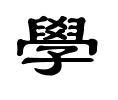
Watch picture and learn character (22)Learn - 学(學)

 The evolution of character Learn


From left to right


Shell bone, bronze, big seal, small seal, clerical scripts, 

and simplified song typeface


Learn counting


Pinyin of character LearnXue2


Explanation


Shell Bone Script of character Learn: The top sides are two hands, two X on the middle are sticks for counting. 


Bronze script of character Learn: The top is same as shell bone script, the door-like part is two legs of an adult, the bottom is character Child who is learning how to count.


Big seal script of character Learn: Similar to bronze script.


Small Seal Script of character Learn: Similar to big seal script.


Clerical Script of character Learn: The top is similar to small seal script, the door-like part is smaller, the bottom is character Child of clerical script.


Simplified song typeface of character Learn: The top become three dots, lost the pictography. The middle and bottom are similar to clerical script.


Friday, June 7, 2024

Watch picture and learn character (21)Drum - 鼓

 The Evolution of character Drum


From left to right


Shell bone, bronze, small seal, and clerical scripts


Drumming 


The pinyin of character DrumGu3


Explanation


Shell Bone Script of character Drum: The left is a drum we learnt in the section of character Happy, the right is a drumstick held by a hand. A person is drumming. Actually, the character should be called Beat drum, not Drum. But why it made the verb to be a noun, I don’t know.


Bronze script of character Drum: The left is similar. The right top drumstick is changed a lot, the bottom is the hand.


Small Seal Script of character Drum: Similar to bronze script.


Clerical Script of character Drum: Similar to small seal script.


Monday, June 3, 2024

Watch picture and learn character (20) Happy - 喜

The evolution of character Happy

From left to right

Shell bone, bronze, small seal, and clerical scripts


Ancient Drum


Ancient Drumming and Singing Artist


The pinyin of character HappyXi3


Explanation 


Shell bone script of character Happy: The top is a drum. 


The inside of 口 is empty which is more like the drum. Because the shell bone script is not unified, there are different forms of the character Drum. One line inside the square emphasizes the part of drum where the drumstick hits. The bottom are two support legs. When the artist beats the drum, which is a sign that the show would start soon, the audiences are smiling because they are happy for the upcoming show. 


Bronze script of character Happy: Similar to shell bone script.


Small seal script of character Happy: Similar to big seal script.


Clerical script of character Happy: Some similarity to older scripts, but all curves are straight lines now, lost most pictography.


Two character  form a new informal character “Double Happiness” as the one below


Which is widely used in China, as long as you see big “Red Double Happiness” character on door, window, the wall of room, the window of car, you should know that some people are getting married right now, and just married a few days ago. Therefore, Double Happiness is the most used character in China because most people could use it at least once in their life. 


However, it is not official character, you can’t find it in any dictionary. Strictly speaking, it is not accepted by experts, and government. But no one says it is wrong, and all people have used it for at least hundreds of years. 


I hope that the experts recognize this contradiction, accept it as formal character, and include it in the dictionary 

Watch picture and learn Chinese (33) Have - 有

 T he evolution of character Have is       From left to right   Bronze, big seal, small seal, clerical scripts; song typeface     Carrying m...